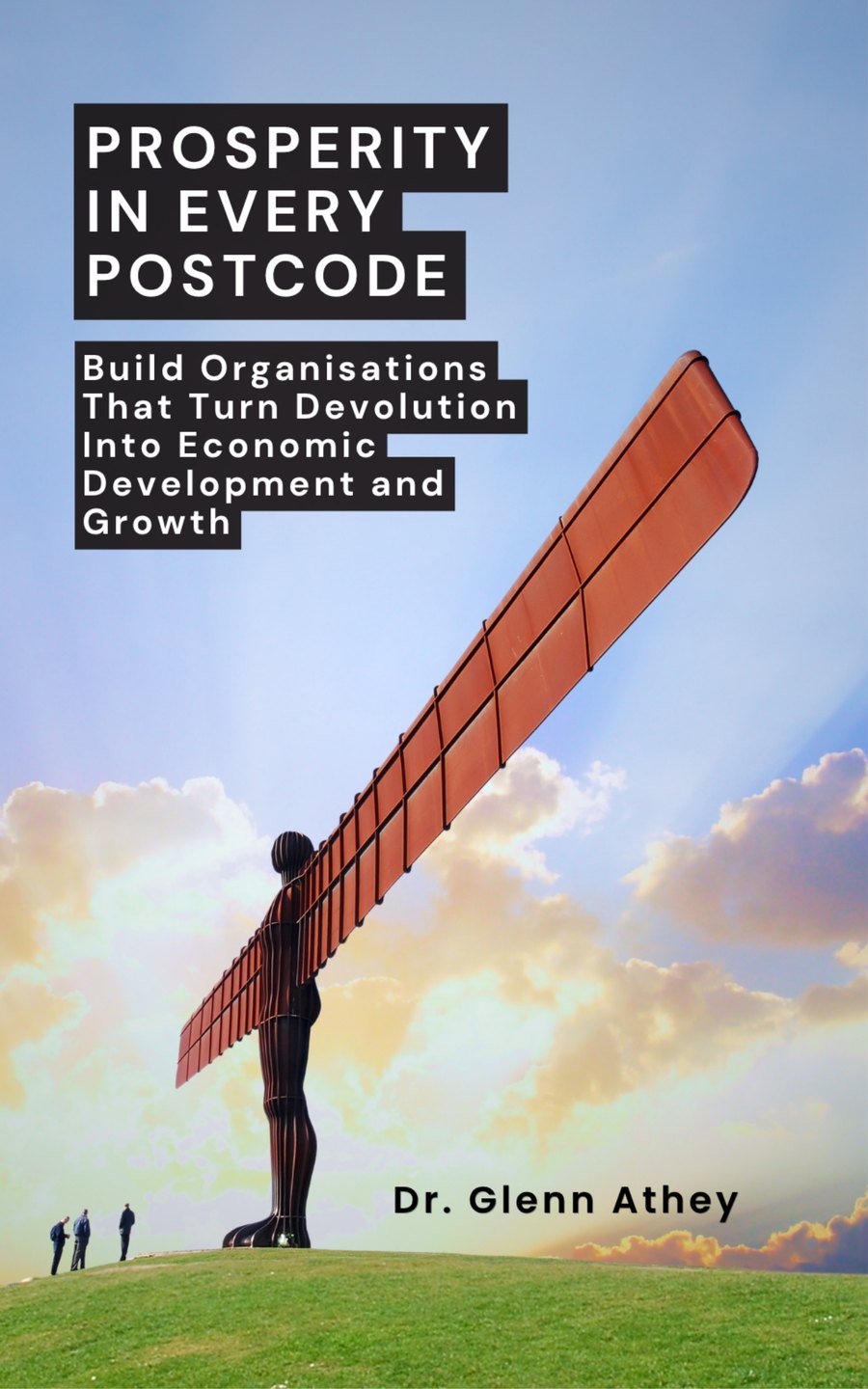
Prosperity in Every Postcode
Build Organisations That Turn Devolution Into Economic Development and Growth
Do you want to learn the disciplines that separate places that deliver from places that can only dream? Power, money and responsibility for growth are moving to mayors, strategic authorities and councils. This book asks whether the institutions receiving them can deliver – and sets out what they have to build to do so.
What the book is about
For forty years England has tried to close the gap between its prosperous and struggling places, and the map of prosperity still looks much as it did in the late 1970s. The ideas were rarely the problem. The machinery beneath them was.
So this book goes inside the building. How to understand how your economy got where it is, and what is actually causing its problems. How to discover what is attainable, instead of copying a list of priority sectors. How to have projects ready before the funding window opens, stop the weak ones before they start, and find out what worked. And the partnership, people, culture and leadership that decide whether any of it takes root.
It is not a strategy document and it is not a toolkit. There are no holy grails of local and regional economic development: no formula, no transplantable model, no single lever that works everywhere. What there is, instead, is a set of disciplines and capabilities that make institutions great at delivery. Prosperity in Every Postcode is an operating philosophy for the people responsible for the results.
Capacity and capability beat advocacy. Readiness is buildable. Building it is what this book is for.From the Introduction: Do You Want to Be Great at This?
Why now: the ten-year test
Devolution is supported by every major political party. The argument about whether to devolve is over. The argument that matters now is whether the institutions receiving power can use it well, and quickly.
Quickly, because the window is shorter than it looks. The Regional Development Agencies got thirteen years from statute to closure. The Local Enterprise Partnerships got thirteen. The Regional Growth Fund got seven. Every combined authority, council and devolved administration now faces a ten-year test, with the first serious political appraisal arriving around year five. Institutions that can show results will keep their powers and win more.
None of what the book asks needs new powers or legislation. You can start today.
Same money, same powers, different results
Two places receive the same funding allocation on the same day. Place A is contracting within months, because it already holds a pipeline of appraised projects. Place B starts deciding what to do on the day the money is confirmed. Eighteen months later, construction cost inflation means its project can’t be finished and the grant drawn down in time.
The difference was machinery, and machinery is what this book is about. Here is what you get from reading it.
Hard-won lessons from practice
Diagnosis, foresight, project development, appraisal, delivery, evaluation, partnership, team building and leadership, grounded in named places and real numbers: Grimsby, Hull, Stavanger, Greater Manchester, Singapore, Salford Quays.
What great looks like
Each chapter closes with the features of a great economic development organisation, written so you can hold your own institution up against them and answer yes or no, and five steps to becoming great.
Actions you can start this quarter
Three per chapter, each naming the output, the owner, the time it takes and the first step. Write a ten-page economic biography of your area. Build a register of every live project with its honest stage. Hand your latest performance report to someone in finance and ask them to find the three biggest problems in ten minutes.
Three things first, then the rest
The conclusion prioritises on your behalf: establish the cause, build the pipeline and the filter, record the baselines. Then what to do in the first ninety days, the first year, and years two to five.
Score your own institution in ten minutes
The book opens with a self-assessment built on its five questions: five capabilities, four levels each, from absent to great. It is not a test you can fail and nobody outside the room needs to see it. What it gives you is a baseline and a shape, and it tells you which chapters to read first.
- What’s the cause - and are you sure you know?Chapters 3 and 4
- What’s possible?Chapters 5 and 6
- What will you build - and what will you stop doing?Chapter 7
- If delivery isn’t working - why?Chapter 8
- How will you know it worked - and that it benefited who you said it would?Chapters 9 and 13
The journey: five destinations
Thirteen chapters, an introduction and a conclusion. Five parts, one argument.
The Reckoning
Why forty years of spatial policy have not shifted Britain’s regional disparities, and the same honesty turned on the field’s own habits.
The Truth
Understand how your economy actually got here and what is really causing its condition. Everything downstream of a wrong diagnosis is waste.
Discovery
The part most books in this field do not have: generating solutions with ideas and foresight, backing the right businesses, and fusing ambition with credibility.
The Work
Delivery: developing impactful solutions and stopping poor ones, asking why when delivery stalls, and the learning organisation that can prove its case to a sceptical Treasury.
Leadership
Partnership that matches the complexity of the economy, the organisation and people that decide whether any of it takes, leadership that takes everyone with you, and the standard the whole endeavour is judged by.
Who this book is for
The people doing this work: economic development officers and directors in strategic, combined and local authorities, chief executives, council leaders and portfolio holders, board and scrutiny members, and the civil servants who negotiate devolution deals with them.
It pairs with The Local and Regional Economic Development Handbook. The Handbook is the reference for the whole field; this book is the judgement, disciplines and leadership that make the machinery work. Explore the Handbook here.
What readers are saying
“Glenn Athey has written the book the new devolved institutions need before they need it. He is unflinching about forty years of central failure, but braver still in holding a mirror up to those of us who lead locally. If you are building a strategic authority or a new unitary council and you want it to deliver, not just announce, read this now.”
Rob Huntington Chief Executive, Rossendale Borough Council
“What a brilliant book! It shines an important light on how to actually make economic development work at what is a pivotal time in the industry. I wish I had this years ago!”
James Cushing Head of Local Growth, Connected Places Catapult
“This is the ultimate actionable guide to delivering great local economic development. Not only a must-read, it’s a must-do, with practical tips and solutions backed by evidence and best practice.”
Adam Breeze Director, State of Tennessee for UK & Ireland, and Inward Investment Consultant
Stay in touch
Join the list for extracts, new resources and news of the book, the Handbook and Economic Development World.